Back to Blog

GPT-5.5 vs Claude Opus 4.7: The Complete 2026 Showdown (Benchmarks, Pricing & Real-World Use)

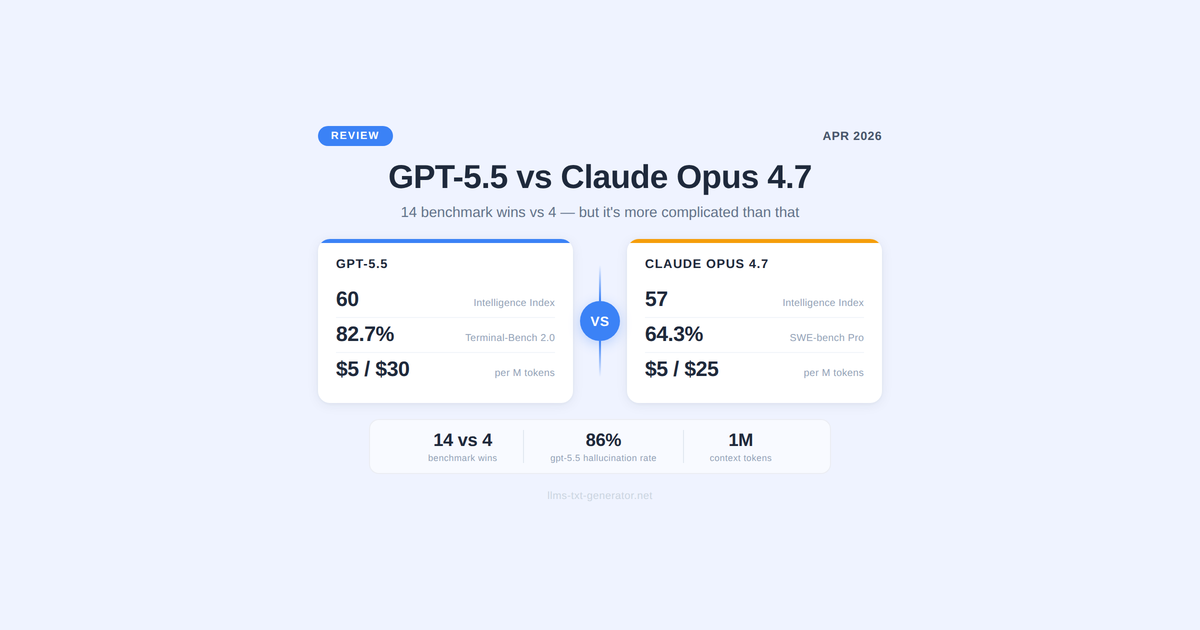
OpenAI launched GPT-5.5 on April 23, 2026 — its first fully retrained base model since GPT-4.5 — beating Claude Opus 4.7 on 14 benchmarks. But Opus 4.7 still wins on SWE-bench Pro and vision. Here's the honest head-to-head, with benchmarks, pricing, hallucination rates, and which one to pick for your workflow.

LLMs.txt GeneratorApril 24, 202612 min read12 views
GPT-5.5 vs Claude Opus 4.7: The Complete 2026 Showdown (Benchmarks, Pricing & Real-World Use)

The Frontier Just Got a New Contender

Seven days after Anthropic shipped Claude Opus 4.7, OpenAI answered. On April 23, 2026, OpenAI released GPT-5.5 — codenamed "Spud" — its first fully retrained base model since GPT-4.5. The architecture is new. The pretraining corpus is new. The agent objectives are new. And the benchmark results are loud.

GPT-5.5 scores 60 on the Artificial Analysis Intelligence Index — three points ahead of Opus 4.7 and Gemini 3.1 Pro Preview, both at 57. It claims state‑of‑the‑art on 14 benchmarks to Opus 4.7's 4 and Gemini 3.1 Pro's 2. It leads Terminal‑Bench 2.0 by a commanding 13 points.

But the story isn't that simple. Opus 4.7 still wins SWE‑bench Pro by 5.7 points. Its vision capabilities process images at 3.3× higher resolution. And GPT-5.5's hallucination rate on AA‑Omniscience is 86% — the highest ever recorded, versus Opus 4.7 at 36%.

So which one should you actually use? We pulled benchmarks from both official system cards, pricing sheets, community tests, and methodology caveats. Here's the honest head‑to‑head.

Quick Specs Side-by-Side

Feature

GPT-5.5

Claude Opus 4.7

Release date

April 23, 2026

April 16, 2026

Architecture

First fully retrained base since GPT-4.5

Iteration on Opus 4 family

Context window

1M tokens

1M tokens

Multimodality

Natively omnimodal (text/image/audio/video)

Text + vision (3.3Ă— resolution jump)

Pricing input

$5 / 1M tokens

$5 / 1M tokens

Pricing output

$30 / 1M tokens

$25 / 1M tokens

Pro tier

GPT-5.5 Pro at $30 / $180

No Pro tier

Intelligence Index

60 (leader)

57

Benchmark SOTA count

14 benchmarks

4 benchmarks

Benchmark Scorecard: Who Wins Where

On the 10 benchmarks where both providers publish comparable scores, Opus 4.7 leads on 5 and GPT-5.5 leads on 5. But the pattern of wins is what matters: Opus 4.7 dominates reasoning‑heavy and review‑grade tests. GPT-5.5 dominates long‑running tool‑use tests.

Benchmark

What It Tests

GPT-5.5

Opus 4.7

Winner

Terminal-Bench 2.0

CLI agentic workflows

82.7%

69.4%

GPT-5.5 (+13.3)

OSWorld-Verified

Desktop computer use

78.7%

78.0%

GPT-5.5 (+0.7)

MRCR v2 (1M tokens)

Long-context retrieval

74.0%

—

GPT-5.5

GDPval

Economic knowledge work

84.9%

—

GPT-5.5

CyberGym

Cybersecurity tasks

Leader

—

GPT-5.5

SWE-bench Pro

Real GitHub issues, multi-lang

58.6%

64.3%

Opus 4.7 (+5.7)

SWE-bench Verified

Curated coding problems

—

87.6%

Opus 4.7

MCP-Atlas

Scaled tool use

75.3%

79.1%

Opus 4.7 (+3.8)

HLE (no tools)

Pure reasoning

41.4%

46.9%

Opus 4.7 (+5.5)

MMMLU

Multilingual Q&A

83.2%

91.5%

Opus 4.7 (+8.3)

Translation: If your workflow is terminal commands, browser automation, computer use, or long‑context retrieval — GPT-5.5 is the new leader. If it's real‑world GitHub coding, reasoning benchmarks, multilingual content, or scaled tool orchestration — Opus 4.7 still wins.

Benchmark Scorecard

What's Genuinely New in GPT-5.5

GPT-5.5 isn't an incremental bump — it's the first architectural reset OpenAI has shipped in nearly 18 months. Three changes matter for production use:

1. Natively Omnimodal

Previous "multimodal" models from OpenAI were pipelines: a vision encoder feeding a text model, with audio handled by separate components. GPT-5.5 is a single unified model that processes text, images, audio, and video end‑to‑end. No stitching, no handoffs between sub‑systems.

In practice, this means richer cross‑modal reasoning: the model can interpret an image and its audio caption together, or analyze a video with its accompanying text commentary as one coherent input.

2. Hardware Co-Design With NVIDIA

GPT-5.5 was co‑designed with NVIDIA's GB200 and GB300 NVL72 rack‑scale systems. OpenAI optimized the model architecture and the serving infrastructure together. The result: Codex rewrote OpenAI's own serving infrastructure before launch, analyzing weeks of production traffic and rewriting load‑balancing heuristics — a 20% boost in token generation speed.

This is genuinely novel: the model tuned the infrastructure that serves it. OpenAI is publicly claiming GPT-5.5 as both product and infrastructure upgrade.

3. Massive Long-Context Jumps

MRCR v2 at 512K–1M tokens went from 36.6% on GPT-5.4 to 74.0% on GPT-5.5 — a 37‑point improvement. GraphWalks BFS at 1M tokens jumped from 9.4% to 45.4%. This fixes one of GPT-5.4's weakest areas and meaningfully narrows the long‑context gap with Gemini 3.1 Pro and Opus 4.7.

Where Opus 4.7 Still Wins

OpenAI's headline marketing is loud, but three categories still clearly favor Claude Opus 4.7:

1. Real-World Software Engineering

SWE‑bench Pro is the gold‑standard benchmark for real GitHub issue resolution across multiple programming languages. Opus 4.7 scores 64.3% vs GPT-5.5's 58.6% — a 5.7‑point gap that matters when your AI agent is operating on production codebases.

SWE‑bench Verified reinforces the pattern: Opus 4.7 posts 87.6%. GPT-5.5 wasn't scored on this one, which is itself telling — OpenAI typically reports on benchmarks where they're competitive.

Production partners confirm the pattern: CodeRabbit reported Opus 4.7 improved recall by 10%+ on their hardest bugs, and Hex called it "the strongest model we've evaluated" for their workflows.

2. Vision

Opus 4.7's vision capabilities are a generational leap. It reads images at up to 2,576 pixels on the long edge (~3.75 megapixels) — roughly 3.3× the resolution of any comparable OpenAI model. On CharXiv‑R (scientific chart reasoning), Opus 4.7 scores 91.0% with tools and 82.1% without.

For workflows involving technical diagrams, whiteboard photos, architectural drawings, or detailed screenshots, this is a substantial practical advantage.

3. Reasoning Without Tools

On HLE (Humanity's Last Exam) without tool access — pure reasoning — Opus 4.7 scores 46.9% vs GPT-5.5's 41.4%. Opus 4.7 also leads on GPQA Diamond, FinanceAgent v1.1, and multilingual Q&A (MMMLU: 91.5% vs 83.2%).

If your agents need to reason reliably without spawning external tool calls — offline analysis, closed‑book QA, translation‑heavy tasks — Opus 4.7 is the stronger default.

The Hidden Cost: GPT-5.5's 86% Hallucination Rate

Here's the number OpenAI's press coverage is quietly glossing over. On Artificial Analysis's AA‑Omniscience benchmark, GPT-5.5 (xhigh) hits the highest‑ever recorded accuracy at 57% — but also the highest‑ever recorded hallucination rate at 86%.

For comparison:

  • GPT-5.5 (xhigh): 86% hallucination rate

  • Gemini 3.1 Pro Preview: 50% hallucination rate

  • Claude Opus 4.7 (max): 36% hallucination rate

AA‑Omniscience measures how often a model confidently asserts something that turns out to be wrong. GPT-5.5 is better at the right answer when it knows one — but also dramatically more willing to confabulate when it doesn't.

For agentic workflows that grade their own outputs as they run, this is a serious risk. A confident wrong action is worse than a stop‑and‑ask. Teams running autonomous agents in production should weigh this heavily.

Hallucination Rate

The Pricing Reality

GPT-5.5's sticker price is $5 / $30 per million tokens — matching Opus 4.7 on input ($5) but 20% higher on output ($30 vs $25). That's the surface story. The actual cost picture is more nuanced:

Pricing Factor

GPT-5.5

Claude Opus 4.7

Input per 1M tokens

$5.00

$5.00

Output per 1M tokens

$30.00

$25.00

Pro tier

$30 / $180

None

Batch / Flex discount

50% off standard

Varies by provider

Priority processing

2.5Ă— standard

Not offered

Output tokens per coding task (relative)

~28% of Opus 4.7

100% baseline

Previous‑generation pricing

GPT-5.4 at $2.50 / $15 — 2× price jump

Opus 4.6 at $5 / $25 — unchanged

Here's the hidden win for GPT-5.5: on identical coding tasks, it produces roughly 72% fewer output tokens than Opus 4.7. That means the 20% higher per‑token output cost flips to a meaningful cost advantage on the same work. For token‑heavy agentic workflows, GPT-5.5 can be cheaper per completed task despite the higher sticker rate.

On the flip side, OpenAI's 2× jump from GPT-5.4's $2.50 / $15 to GPT-5.5's $5 / $30 is the largest single‑release price increase in the GPT-5.x series. Budget‑sensitive teams staying on GPT-5.4 now face a steeper upgrade decision.

Benchmark Caveats You Should Know

Both companies' system cards include methodology caveats that matter:

  1. SWE-bench Pro memorization flag: OpenAI's system card includes an asterisk on SWE‑bench Pro noting "evidence of memorization" from other labs. Anthropic published a decontaminated subset re‑score analysis showing their Opus 4.7 margin holds. Interpret the 5.7‑point Opus 4.7 lead as real but contestable.

  2. Terminal-Bench 2.0 asymmetric reporting: Anthropic's own news page describes Opus 4.7 as having "passed tasks prior Claude models couldn't" but does not publish the absolute 69.4% figure cited in OpenAI's comparison table. OpenAI reports Opus 4.7's Terminal‑Bench score using their own evaluation harness — not Anthropic's.

  3. Intelligence Index composition: Artificial Analysis's Intelligence Index is a weighted aggregate. GPT-5.5's 3‑point lead reflects average performance; on specific sub‑tasks the rankings flip.

  4. Hallucination benchmark variance: AA‑Omniscience's 86% hallucination rate for GPT-5.5 is at the xhigh effort setting. Lower effort settings show lower hallucination rates but also lower accuracy. The trade‑off scales.

Which One Should You Pick?

There's no universal winner. Match the model to your workflow:

Pick GPT-5.5 If You Need

  • Terminal‑heavy agentic workflows: CLI pipelines, Codex automation, DevOps tasks (82.7% Terminal‑Bench)

  • Computer use automation: Browser agents, desktop automation (78.7% OSWorld)

  • Long‑context retrieval at 512K+ tokens: 74% MRCR vs ~36% on prior gen

  • Economic knowledge work: 84.9% GDPval — strongest on 44‑occupation real‑work tasks

  • Frontier math, cybersecurity, browser research: Multiple SOTA leads

  • Token‑efficient production pipelines: 72% fewer output tokens on same coding work

  • Omnimodal tasks: Video + audio + image + text in single pass

Pick Claude Opus 4.7 If You Need

  • Real‑world software engineering: GitHub issue resolution, code review (64.3% SWE‑bench Pro, 87.6% Verified)

  • High‑resolution vision tasks: Technical diagrams, charts, screenshots at 3.75 MP

  • Multilingual content: 91.5% MMMLU vs 83.2% for GPT-5.5

  • Scaled tool orchestration: 79.1% MCP‑Atlas

  • Reasoning without tool access: Closed‑book analysis, pure logic

  • Low hallucination production workflows: 36% vs GPT-5.5's 86%

  • Lower output costs: $25/M vs $30/M when token count is similar

Which One Should You Pick?

The Smart Play: Route Between Both

Most production setups running real agentic workloads now route between both models. GPT-5.5 for standard tool‑use tasks, terminal automation, and high‑throughput pipelines. Opus 4.7 for the hard coding tasks, vision‑heavy workflows, and anywhere hallucination cost is high.

The model‑routing layer (via providers like OpenRouter, or self‑built via the APIs directly) is rapidly becoming a standard production pattern. Pure‑single‑model strategies are starting to look outdated.

What This Means for Your Website

As both GPT-5.5 and Opus 4.7 agents become standard in production — Claude Code, Codex, GitHub Copilot, AWS Bedrock, Google Vertex AI — more autonomous AI agents will be reading your website on behalf of users.

Every one of these agents — whether it's a GPT-5.5 browser automation researching a product, an Opus 4.7 code review agent scanning your docs, or a Codex pipeline pulling your API reference — needs one thing: structured, machine‑readable content.

The websites that get cited, referenced, and acted upon by these agents share three traits: clean server‑rendered HTML, JSON‑LD structured data, and an llms.txt file at the root telling agents exactly what the site covers.

Generate your free llms.txt file in 60 seconds — make your site visible to every major AI agent, regardless of which frontier model wins the next leaderboard war.

Conclusion

GPT-5.5 is a real frontier release. The first fully retrained base model since GPT-4.5, the highest Intelligence Index score publicly available, 14 benchmark wins, and a natively omnimodal architecture. That's not hype — that's measurable progress.

But it ships with a 86% hallucination rate at xhigh, a 2× price jump from GPT-5.4, and losses to Opus 4.7 on the coding benchmarks that matter most in production (SWE‑bench Pro, Verified, MCP‑Atlas). The honest read isn't "GPT-5.5 beats Opus 4.7" or vice versa — it's that the frontier has bifurcated into specialties.

The next 6 months will see Opus 5, GPT-5.5 Pro adoption, Gemini 4.0, and Grok 5 all ship. The model routing approach — GPT-5.5 for tool‑heavy tasks, Opus 4.7 for reasoning and coding review — is the production pattern that will persist regardless.

And as AI agents increasingly dominate web traffic, the single biggest move you can make for your website is making it AI‑readable. Generate your free llms.txt file → and get cited by every agent regardless of which model they run on.

Frequently Asked Questions

When did GPT-5.5 launch?

OpenAI released GPT-5.5 on April 23, 2026, with API availability starting April 24. It's deploying to Plus, Pro, Business, and Enterprise tiers in ChatGPT. GPT-5.5 Pro (the higher‑tier model at $30/$180 per million tokens) is available to Pro, Business, and Enterprise users.

Is GPT-5.5 better than Claude Opus 4.7?

It depends on the task. GPT-5.5 wins on Terminal‑Bench 2.0 (82.7% vs 69.4%), OSWorld-Verified (78.7% vs 78.0%), GDPval, CyberGym, and long‑context retrieval. Opus 4.7 wins on SWE‑bench Pro (64.3% vs 58.6%), SWE‑bench Verified (87.6%), MCP‑Atlas, HLE without tools, MMMLU multilingual, vision tasks (3.3× higher resolution), and has a dramatically lower hallucination rate (36% vs 86%). For coding and reasoning tasks, Opus 4.7 is often stronger. For terminal automation and agentic tool use, GPT-5.5 leads.

What is GPT-5.5's hallucination rate?

On Artificial Analysis's AA‑Omniscience benchmark, GPT-5.5 at the xhigh effort setting hits 86% hallucination rate — the highest ever recorded. By comparison, Claude Opus 4.7 at max effort hits 36%, and Gemini 3.1 Pro Preview hits 50%. GPT-5.5 is more accurate when it knows the answer but more likely to confidently fabricate when it doesn't. This is a serious consideration for autonomous agentic workflows.

How much does GPT-5.5 cost?

GPT-5.5 is priced at $5 per million input tokens and $30 per million output tokens — a 2× increase from GPT-5.4's $2.50/$15 pricing (the largest single‑release price jump in the GPT-5.x series). GPT-5.5 Pro costs $30/$180 per million tokens. Batch and Flex pricing offers 50% off the standard rate; Priority processing costs 2.5× the standard rate.

What's special about GPT-5.5 being "fully retrained"?

Every model between GPT-4.5 and GPT-5.5 — including GPT-5.1, 5.2, 5.3, and 5.4 — was a post‑training iteration on the same base model. GPT-5.5 is the first ground‑up retraining in ~18 months, with a reworked architecture, new pretraining corpus, and agent‑oriented objectives. It's also OpenAI's first natively omnimodal model, processing text, images, audio, and video in a single unified system.

Does GPT-5.5 have a 1M token context window?

Yes. GPT-5.5 is OpenAI's first API model to ship with a 1 million token context window. Long‑context retrieval improved dramatically: MRCR v2 at 1M tokens jumped from 36.6% (GPT-5.4) to 74.0%, and GraphWalks BFS at 1M tokens went from 9.4% to 45.4%.

Should I switch from Opus 4.7 to GPT-5.5?

Not automatically. If your production workflows lean on SWE‑bench Pro‑style real coding tasks, reasoning without tools, vision analysis, or multilingual content — stay on Opus 4.7 or use both. If you run terminal‑heavy pipelines, browser automation, or long‑context research tasks — GPT-5.5 is now the leader. Most production setups should evaluate model routing rather than a full switch.

Why did OpenAI codename GPT-5.5 "Spud"?

"Spud" was the internal codename used during development. OpenAI hasn't publicly explained the origin, though the community has noted it parallels Anthropic's "Mythos" codename — both are memorable internal names that leaked before the public release. Prediction markets spent weeks debating whether Spud would ship as GPT-5.5 or GPT-6; OpenAI chose the point‑release name despite it being a fully retrained base.

Can GPT-5.5 beat Claude Mythos?

On Terminal‑Bench 2.0 specifically, VentureBeat reported GPT-5.5 "narrowly beats Anthropic's Claude Mythos Preview" — a restricted model not publicly available. Mythos isn't accessible to the general public (only ~50 organizations via Project Glasswing), so this comparison remains largely theoretical for most users. Against publicly‑accessible models, GPT-5.5's primary rival is Claude Opus 4.7.

How does this affect AI search and website visibility?

As GPT-5.5 and Opus 4.7 agents become standard in Codex, Claude Code, GitHub Copilot, AWS Bedrock, and Google Vertex AI, they will increasingly browse and cite websites autonomously. Getting cited by these agents requires clean server‑rendered HTML, JSON‑LD structured data, and a proper llms.txt file at your root domain. Generate your free llms.txt file to make your website discoverable regardless of which model powers the visiting agent.

Filed under
GPT-5.5
Claude Opus 4.7
OpenAI
Anthropic
AI benchmarks
SWE-bench
Terminal-Bench
GDPval
AI models 2026
Codex

Ready to optimize your website for AI?

Generate your llms.txt file for free in seconds.

Try the Generator