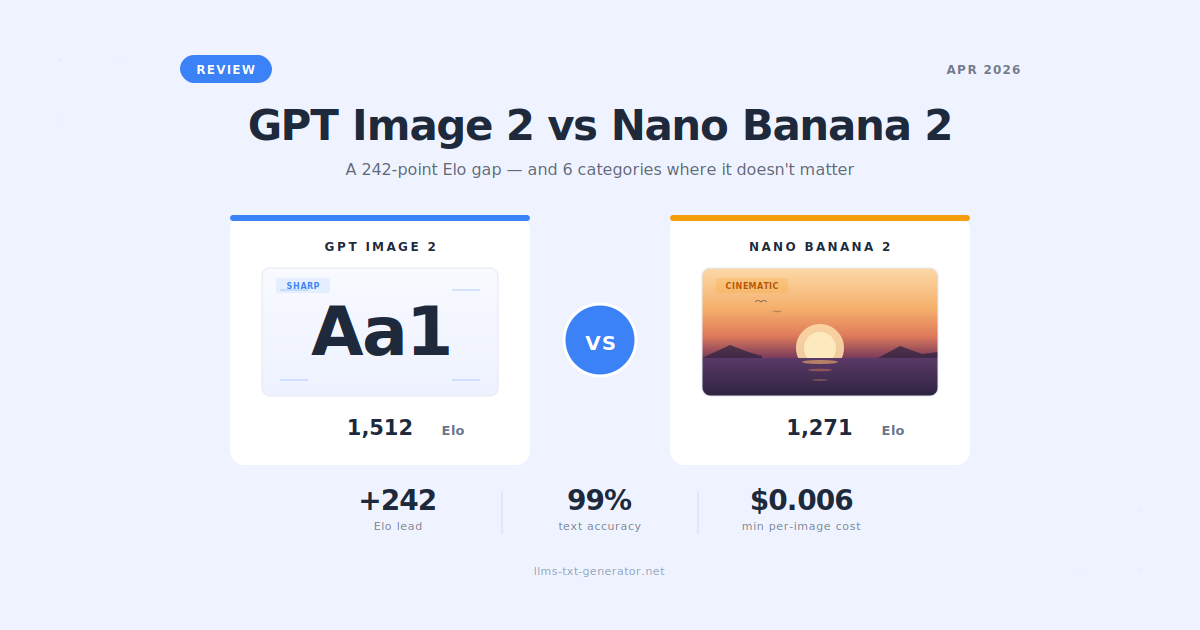
OpenAI Just Took the Image Crown — But It's Complicated
On April 21, 2026, OpenAI released GPT Image 2 (officially ChatGPT Images 2.0, API model gpt‑image‑2), and within 12 hours it claimed the #1 spot across every category on the Image Arena leaderboard — with a +242 Elo point lead over the nearest competitor. That's the largest margin of any model over its runner‑up in the history of the Text‑to‑Image Arena.
The nearest competitor? Google's Nano Banana 2 (Gemini 3.1 Flash Image), which launched February 26, 2026 and held the top slot until April 21 — and which still beats GPT Image 2 in several important categories despite dropping to #2 overall.
For anyone generating images for marketing, blog posts, product mockups, or social content, this is now the most important head‑to‑head in AI. We pulled the benchmarks, tested the claims, and compared pricing, speed, and real‑world output across 7 categories. Here's the honest review of which one actually wins — and for what.
What Is GPT Image 2?
GPT Image 2 is OpenAI's fourth‑generation image model and the direct successor to GPT Image 1.5 (which itself replaced DALL‑E 3 in 2025). The key architectural change: it's the first OpenAI image model with native reasoning — a "Thinking mode" that lets the model research, plan, and self‑check before generating pixels.
Technical specs at launch:
API model ID:
gpt‑image‑2Max resolution: 2K standard, 4K experimental
Batch generation: Up to 8 images per prompt
Text rendering accuracy: 99%+ (compared to 90–95% in previous models)
Multilingual: High‑fidelity text in English, Japanese, Korean, Chinese, Hindi, Bengali
Pricing: $8/M input tokens, $32/M output tokens; per‑image from $0.006 (low, 1024x1024) to $0.211 (high, 1024x1024)
Limitations at launch: No transparent PNG support;
input_fidelityparameter disabled
Downstream integrations already shipped: Figma, Canva, Adobe Firefly, fal, and Hermes Agent.
What Is Nano Banana 2?
Nano Banana 2 is Google's latest image model (officially Gemini 3.1 Flash Image), launched February 26, 2026. It's the successor to the viral Nano Banana (August 2025) and Nano Banana Pro (November 2025). The nickname originated from Naina Raisinghani, a Google DeepMind product manager.
Technical specs:
API model ID:
gemini‑3.1‑flash‑image‑previewResolution range: 512px to native 4K
Subject consistency: Up to 5 characters and 10 objects in a single workflow
Multi‑reference images: Up to 14 reference images supported (Banana Pro)
World knowledge: Pulls from real‑time Google Search
Content authenticity: SynthID watermarking + C2PA content credentials (used 20M+ times since November 2025)
Pricing: $0.045 to $0.151 per image
Default availability: Free across the Gemini app, AI Mode, Google Lens, and Google Search in 141 countries
Benchmarks: The 242-Point Elo Gap
Before GPT Image 2 launched, Nano Banana 2 held the #1 position on the Image Arena leaderboard with an Elo of 1,360 (open gap over GPT Image 1.5 at 1,264). Then GPT Image 2 dropped:
Model | Text‑to‑Image Elo | Single‑Image Edit Elo | Multi‑Image Edit Elo | Launch Date |
|---|---|---|---|---|
GPT Image 2 | 1,512 (#1) | 1,513 (#1) | 1,464 (#1) | April 21, 2026 |
Nano Banana 2 | 1,271 (#2) | 1,825 (#2) | — | February 26, 2026 |
Nano Banana Pro | 1,258 | 2,726 (before IE 2) | — | November 2025 |
GPT Image 1.5 (High) | 1,241 | — | — | 2025 |
The most striking detail: GPT Image 2 at medium quality outperforms GPT Image 1.5 at maximum quality by 271 Elo points. That's how large the architectural jump is.
On the image editing leaderboard specifically, GPT Image 2 scored 2,726 Elo — taking the top position by a wide margin over Nano Banana 2 at 1,825.
Head-to-Head: Who Wins Each Category
Raw leaderboard scores don't tell the whole story. Different tasks favor different models. Here's the category‑by‑category breakdown from reviewers who tested both on identical prompts:
1. Text Rendering — GPT Image 2 Wins
GPT Image 2 achieves near‑100% character‑level accuracy, outperforming Nano Banana Pro on UI labels, signage, and short multilingual text. One LM Arena tester observed: "The gap between it and Nano Banana Pro is as significant as the gap between Nano Banana Pro and DALL‑E."
Caveat: for long‑form paragraph text (dense infographics, document‑style posters), Nano Banana Pro still has an edge on readability. GPT Image 2 hasn't been rigorously tested on dense paragraph blocks yet.
2. Photorealism — Nano Banana 2 Wins
On photorealistic prompts — textures, fur, fabric, dynamic lighting — Nano Banana 2 still produces more convincing output. In one pet anthropomorphism test, Nano Banana 2 nailed fur textures and the natural drape of clothing. GPT Image 2's version was structurally correct but felt more like a polished render than a photograph.
If your use case is lifestyle imagery, e‑commerce product shots, or cinematic scenes, Nano Banana 2 remains the stronger default.
3. Spatial Logic & Layout — GPT Image 2 Wins
In a "technical layout" test where the prompt asked for a clean 3x3 grid of outfit items on a white background:
GPT Image 2: Executed the grid with architectural precision, clean boundaries between objects
Nano Banana 2: Blended items together, treated the grid as a suggestion rather than a strict instruction
For infographics, UI mockups, diagrams, and structured compositions, GPT Image 2 is the clear winner.
4. Speed — Effectively a Tie
Both models now generate in similar time windows:
GPT Image 2: ~3 seconds per generation (quality = low)
Nano Banana 2 (Flash): 3–5 seconds per generation
Nano Banana Pro: 10–15 seconds per generation
The speed story is less about GPT Image 2 vs Nano Banana 2 and more about Nano Banana Pro being the slower, higher‑quality tier of Google's lineup.
5. Multi-Reference / Character Consistency — Nano Banana Pro Wins
This is the single biggest gap in Google's favor. Nano Banana Pro supports up to 14 reference images in a single workflow, making it ideal for:
Character locking across a storyboard
Multi‑subject fusion
Brand visual system generation (5 characters, 10 objects consistent)
GPT Image 2's reference image support at launch appears limited to standard image‑to‑image mode. The number of reference images it can accept and its persistent embedding mechanism haven't been fully disclosed.
6. Pricing — Nano Banana 2 Wins for Bulk
Nano Banana 2 is cheaper for high‑volume generation:
Cost Comparison | GPT Image 2 | Nano Banana 2 |
|---|---|---|
Cheapest per‑image | $0.006 (low, 1024x1024) | $0.045 |
Standard per‑image | $0.15–$0.20 typical | $0.075 |
Highest per‑image | $0.211 (high, 1024x1024) | $0.151 |
API tokens | $8/M input, $32/M output | Included in Gemini API pricing |
Free tier | Limited | Available in Gemini app, Search, Lens |
Note: GPT Image 2's cheapest tier at $0.006 is genuinely lower than Nano Banana 2's minimum, but that's for quality=low. At typical production quality, Nano Banana 2 is the cheaper option.
7. Image Editing — GPT Image 2 Dominates
On the image editing leaderboard, GPT Image 2 scored 2,726 Elo — far ahead of Nano Banana 2 at 1,825. If your workflow involves editing existing images (inpainting, outpainting, localized modifications, multi‑image composition), GPT Image 2 is the clear leader.
The "Thinking Mode" That Changes Everything
The single most significant architectural change in GPT Image 2 is the integration of OpenAI's "O‑series" reasoning capabilities into image generation. Historically, image models operated as black boxes: prompt in, one image out.
GPT Image 2's Thinking mode changes this:
Research: The model searches the web when paired with a thinking model
Plan: It maps the image composition before drawing anything
Multiple candidates: It generates several drafts internally
Self‑check: It evaluates outputs against the prompt before returning
This produces genuinely novel capabilities: slides, infographics, diagrams, UI mockups, QR codes, and maps generated with a level of structural coherence that previous image models couldn't achieve.
Thinking mode is restricted to ChatGPT Plus, Pro, and Business subscribers at launch. Enterprise rollout is expected soon.
Content Authenticity: Where Google Still Leads
One important area where Google is ahead: content authenticity infrastructure. Every image generated by Nano Banana 2 is watermarked with SynthID and carries C2PA content credentials (the standard developed jointly with Adobe, Microsoft, OpenAI, and Meta).
SynthID verification has been used over 20 million times since November 2025. This matters for:
Publishers who need to prove image provenance
Enterprises subject to content disclosure regulations
Anyone building trust workflows around AI‑generated media
OpenAI is a C2PA partner but the rollout of watermarking on GPT Image 2 outputs is less visible than Google's. For regulated industries, this is a real consideration.
Which One Should You Pick?
There's no clean winner. The answer depends entirely on what you're generating:
Pick GPT Image 2 If You Need
Text‑heavy designs: Posters, UI mockups, signage, infographics
Precise grid and layout compositions: Product lineups, comparison grids, structured diagrams
Editing‑heavy workflows: Inpainting, outpainting, localized modifications
Multilingual text rendering: Japanese, Korean, Chinese, Hindi, Bengali at high fidelity
Slides, presentations, maps: Where structural accuracy matters more than photorealism
Reasoning‑dependent generation: When you want the model to research and plan before drawing
Pick Nano Banana 2 If You Need
Photorealistic lifestyle imagery: Product shots, fashion, food, human subjects
Atmospheric or cinematic lighting: Moody scenes, dramatic compositions
Multi‑reference character consistency: Up to 14 references, 5 characters, 10 objects
Bulk generation at lower cost: $0.045–$0.075 typical vs $0.15–$0.20 for GPT Image 2
Free tier availability: Available in Gemini app, Google Search, Lens
Content authenticity: SynthID + C2PA watermarking out of the box
What This Means for Website Owners and Content Creators
AI image generation just crossed a quality threshold where featured images, infographics, and social cards are all viable to produce in‑house. For website owners and content creators, this has two immediate implications:
1. Alt text and structured data now matter more. AI agents increasingly browse the web, and many of them can now also generate and consume images natively. Your AI‑generated featured images need proper alt text, Open Graph tags, and structured data. Otherwise AI agents see your visual content as a black box they can't interpret.
2. AI‑readability of your site is the new SEO foundation. The same AI systems that can generate these images (GPT Image 2, Nano Banana 2) are also browsing and citing websites. A clean, structured website with proper metadata gets cited more often — and the single highest‑impact step is publishing an llms.txt file at your domain root.
Generate your free llms.txt file in 60 seconds — the same principle that makes your website AI‑agent readable is what makes your content visible in the AI search era.
Conclusion
GPT Image 2's 242‑point Elo lead is real, impressive, and historic. But Elo scores don't capture the categories that matter for most production workflows: photorealism, multi‑reference consistency, and price per image. Nano Banana 2 still wins on all three.
The honest verdict: most serious content teams will end up using both. GPT Image 2 for text‑heavy work, editing, and structural compositions. Nano Banana 2 for photorealistic imagery, character‑consistent storyboards, and bulk pipelines.
The 6‑month arc from "AI images are obviously fake" to "AI images are production‑ready" has happened remarkably fast. The next 6 months will decide whether Nano Banana Pro or GPT Image 2's rumored "Pro" tier takes the next leaderboard crown.
And as AI‑generated content floods the web, the websites that remain discoverable by AI agents will be the ones with clean structure and a proper llms.txt file. Generate yours free →
Frequently Asked Questions
When did GPT Image 2 launch?
OpenAI released GPT Image 2 (officially ChatGPT Images 2.0, API model gpt‑image‑2) on April 21, 2026. It's available to all ChatGPT users, with the Thinking mode restricted to Plus, Pro, and Business subscribers. Enterprise rollout is expected soon.
When did Nano Banana 2 launch?
Google launched Nano Banana 2 (officially Gemini 3.1 Flash Image) on February 26, 2026 as the default image model across the Gemini app, Google Search, Lens, and AI Mode in 141 countries. For developers, it's available via the Gemini API as gemini‑3.1‑flash‑image‑preview.
What is the Elo gap between GPT Image 2 and Nano Banana 2?
GPT Image 2 leads the Text‑to‑Image Arena by +242 Elo points (1,512 vs 1,271), the largest margin of any model over its runner‑up in the leaderboard's history. On the image editing leaderboard, the gap is even wider: 2,726 vs 1,825.
Which is better for text in images?
GPT Image 2 is significantly better for text rendering, achieving 99%+ character‑level accuracy versus 90–95% on previous models. It handles English, Japanese, Korean, Chinese, Hindi, and Bengali at high fidelity. For long‑form paragraph text (dense infographic bodies), Nano Banana Pro still has a slight edge on readability.
Which is better for photorealistic images?
Nano Banana 2 remains better for photorealistic imagery — fur textures, fabric drape, cinematic lighting, and natural scenes. GPT Image 2's output is structurally correct and neutral but lacks the tactile realism reviewers expect from photographic content.
How much does each model cost per image?
GPT Image 2 ranges from $0.006 (quality=low, 1024x1024) to $0.211 (quality=high, 1024x1024). Typical production quality costs $0.15–$0.20 per image. Nano Banana 2 ranges from $0.045 to $0.151 per image, with standard quality around $0.075. For bulk generation at typical production quality, Nano Banana 2 is the cheaper option.
Which is faster?
Effectively a tie at typical settings. GPT Image 2 generates in ~3 seconds at quality=low. Nano Banana 2 (Flash) generates in 3–5 seconds. Nano Banana Pro, the higher‑quality Google tier, takes 10–15 seconds. For interactive chat experiences, GPT Image 2 and Nano Banana 2 Flash feel nearly identical in responsiveness.
Which one supports multi-reference images better?
Nano Banana Pro wins decisively here. It supports up to 14 reference images in a single workflow, making it ideal for character locking, multi‑subject fusion, and brand visual system generation. It can maintain consistency across up to 5 characters and 10 objects. GPT Image 2's reference image support at launch appears more limited.
Does GPT Image 2 watermark its outputs?
OpenAI is a C2PA partner and supports content credentials, but Google's Nano Banana 2 has a more visible watermarking infrastructure with SynthID. Every Nano Banana 2 image is watermarked with SynthID plus C2PA credentials, with 20M+ verifications since November 2025. For regulated industries or publishers who need strong provenance guarantees, Google's approach is currently more mature.
Should I use GPT Image 2 or Nano Banana 2 for blog featured images and infographics?
For blog featured images with prominent text, structured layouts, category badges, and stats strips (like the ones we use at llms-txt-generator.net), GPT Image 2 is the better choice — its text rendering accuracy and structural layout precision outperform Nano Banana 2 for this specific use case. For lifestyle photography, product shots, or photorealistic hero images, Nano Banana 2 remains the better default. Most blogs will benefit from using both, depending on the image type.
