The Core Update That Changed the Rules
On April 8, 2026, Google confirmed the completion of its March 2026 Core Update — a 12-day rollout that began March 27 and sent shockwaves through the SEO community. It was the first core update of 2026 and one of the most volatile Google has released.
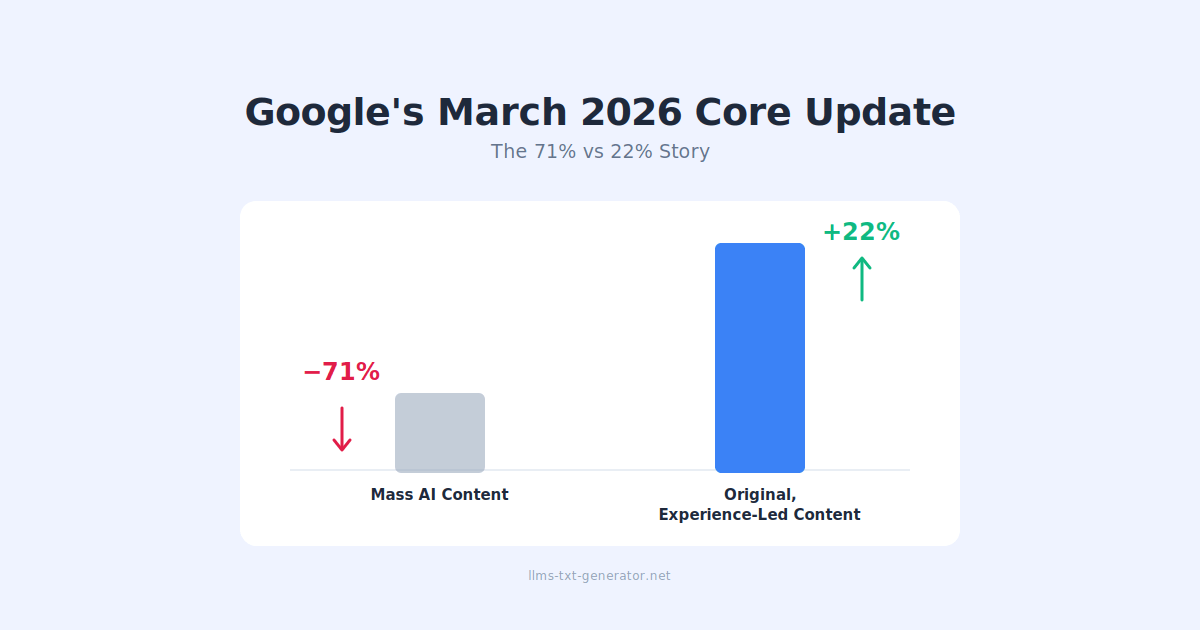
The headline numbers tell the story: mass-produced AI content lost up to 71% of its organic traffic. Original, experience-led content gained 22% visibility. And despite the narrative, this wasn't an "anti-AI" update — 86.5% of top-ranking pages still use AI assistance.
The real signal Google sent: experience, expertise, and information gain now outweigh volume. Here's what changed, who won, who lost, and exactly how to recover if your site took a hit.
Timeline: A 5-Week Triple Hit
The March 2026 Core Update didn't arrive in isolation. It capped a five-week period of compounding algorithm changes that reshaped the search landscape:
February 5–27, 2026: Discover Core Update — Google's first-ever Discover-only labeled core update (22 days)
March 24–25, 2026: Spam Update — the shortest confirmed spam update ever (under 20 hours)
March 27 – April 8, 2026: March 2026 Core Update — 12 days, 4 hours (the second-shortest core update in two years)
Sites that took hits during this window often attributed everything to the core update, but the spam update alone cleared a significant number of low-quality operators. If your traffic dropped between March 24–25, that's a spam-update signal, not the core update.
What Google Officially Said
Google's only on-the-record statement came via the Search Status Dashboard. No companion blog post was published. The key line:
"This is a regular update designed to better surface relevant, satisfying content for searchers from all types of sites."
Google's standing guidance restated that "there's nothing new or special that creators need to do for this update as long as they've been making satisfying content meant for people." Translation: this wasn't a new system — it was a stronger recalibration of the same people-first quality signals Google has been promoting since the Helpful Content Update era.
What Google didn't say out loud: three ranking factors got measurably re-weighted. We'll cover those in detail below.
Winners and Losers
SE Ranking analysis (exclusive to Search Engine Land) showed this was one of the most volatile core updates in recent memory:
Metric | March 2026 | December 2025 (prior update) |
|---|---|---|
Top-3 URLs that changed position | 79.5% | 66.8% |
Top-10 URLs that shifted | 90.7% | 83.1% |
Pages that fell out of top 100 | ~1 in 4 | ~1 in 6 |
SEMrush Sensor peak | 9.5/10 | 7.8/10 |
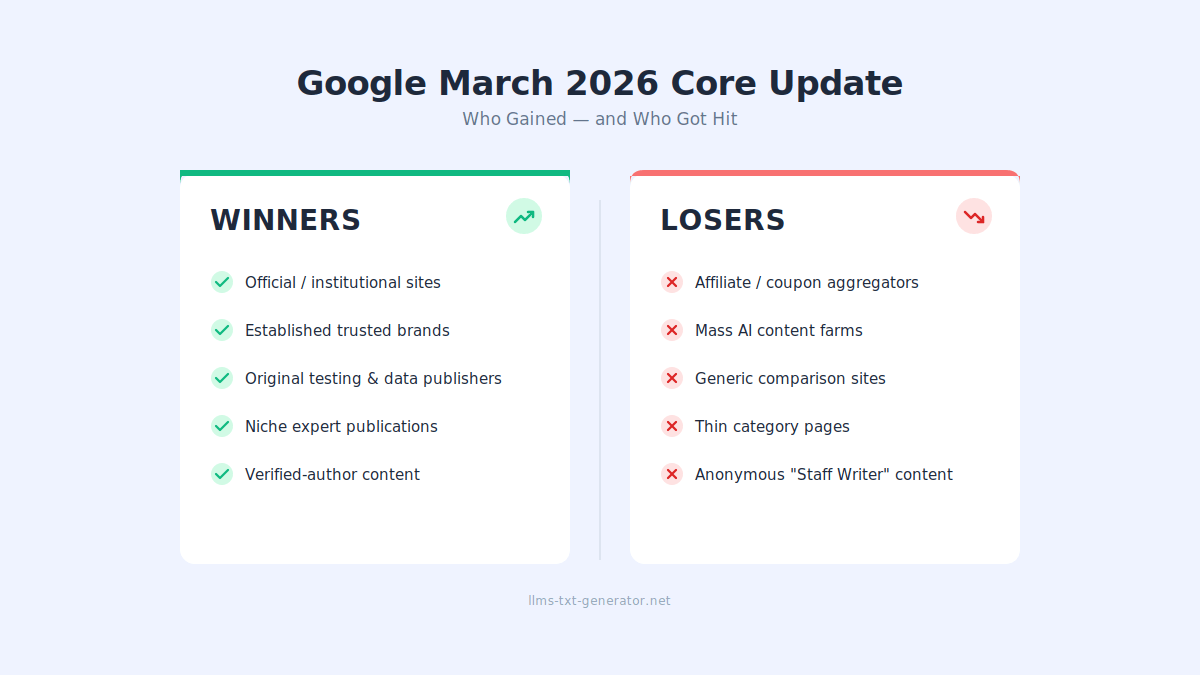
Winners (+15–25% average visibility)
Official / institutional sites: IRS.gov, Reuters, major government domains
Established trusted brands: IMDb, Spotify, Zillow, Hermès, ASOS
Original testing & data publishers: The Wirecutter, RTINGS
Niche expert publications with documented first-hand experience
Sites doing "authority consolidation" — those previously at positions 4–8 moving into the top 3
Losers (–30–80% visibility)
Affiliate sites: 71% of tracked affiliate domains saw negative impact — the highest of any category
AI content farms: 60–80% traffic loss
Generic comparison / aggregator sites: Apartments.com and Homes.com hit hard on local rental queries
Broad retailers on commercial queries (Wayfair, Walmart, Best Buy, Target all affected)
Finance affiliates and coupon aggregators
HubSpot case study: Widely reported 70–80% organic traffic loss across the 2025–2026 update cycle, tied to publishing outside core expertise
As Barry Schwartz put it: "Sites that have been doing everything right — real authors, real experience, real content — are holding steady or gaining. The sites losing ground are the ones that looked like they were doing SEO, but weren't really helping anyone."
The Data That Defines This Update
The most-cited analysis came from JetDigitalPro, which reviewed 600,000+ pages between December 2025 and March 2026. The findings:
Finding | Value | What It Means |
|---|---|---|
Traffic drop: mass-produced AI content | 71% | Unedited AI at scale got crushed |
Visibility gain: original experience content | 22% | First-person, data-backed content surged |
Correlation: AI usage vs penalty | 0.011 | Near-zero — AI use itself is NOT the trigger |
Top-ranking pages using AI assistance | 86.5% | AI-assisted content still dominates SERPs |
YMYL pages with named author credentials | 73% (up from 58%) | E-E-A-T became visibly enforced |
Traffic lost from content not updated in 90 days | 20–40% | Freshness matters more than ever |
The critical nuance: AI is not the penalty trigger — lack of editorial oversight is. Sites that used AI as a drafting tool with expert review and added genuine experience performed well. Sites that published AI output at scale without editorial enrichment were decimated.
The Three Signals That Got Re-Weighted
SEO analysts across Search Engine Land, Search Engine Journal, and independent audit data converge on three ranking factors that clearly received more weight in this update:
1. Information Gain
Google's long-held patent concept became operationally active. Information Gain measures how much genuinely new information a page adds compared to what's already ranking for that query. Regurgitating common knowledge = no gain = no ranking boost.
Independent analysts attribute the detection leap to Google's "Gemini-powered semantic filter," a system that compares page content against the top 20 ranking URLs and scores originality.
2. Verified Author Expertise (E-E-A-T)
Pages with named authors linked to external verification (LinkedIn, published work, credentials) are outranking pages attributed to "Staff Writer" or "Editorial Team." The Experience signal — the first "E" in E-E-A-T — is now the most directly observable component in rankings.
Google now algorithmically distinguishes expertise ("a financial advisor") from experience ("someone who invested through multiple market cycles"). Both matter. Content that blends the two is what ranks.
3. Topical Coherence at Domain Level
Google is evaluating content at both page level AND site level. A great individual AI-assisted article can still rank — but if your domain shows scaled patterns of off-topic, thin, or template-driven content, the whole site gets suppressed.
Winners have deep, focused subject-area coverage. Losers look like they tried to rank for everything and ended up trusted for nothing.
How This Connects to AI Search (GEO)
Here's the part most core-update analyses miss: the signals Google now rewards are the exact same signals that drive AI search citations.
Think about how ChatGPT, Perplexity, and Google AI Overviews choose sources:
They prefer content with information gain — original data, direct answers, unique angles
They weight verified expertise — named authors, credentials, external authority signals
They favor topical coherence — sites known for specific expertise, not generalists
AI Overviews now appear in 82% of B2B tech searches (up from 36% in 2025). Top-result click-through rates drop 34.5% when an AI Overview appears. But brands cited in AI Overviews see 35% more organic clicks and 91% more paid clicks.
This is "The Great Decoupling" — traditional impressions stay high while clicks drop. The only sustainable strategy is becoming one of the cited sources AI engines reference in the first place.
The foundation of that strategy? A clean llms.txt file that tells AI engines exactly what your site covers, who writes it, and why your content is worth citing. Generate yours for free in under 60 seconds.
The 5-Step Recovery Playbook
If your site took a hit, Google's official advice is blunt: "There aren't specific actions you can take to recover. You may see some recovery between core updates, but the biggest changes tend to follow another core update."
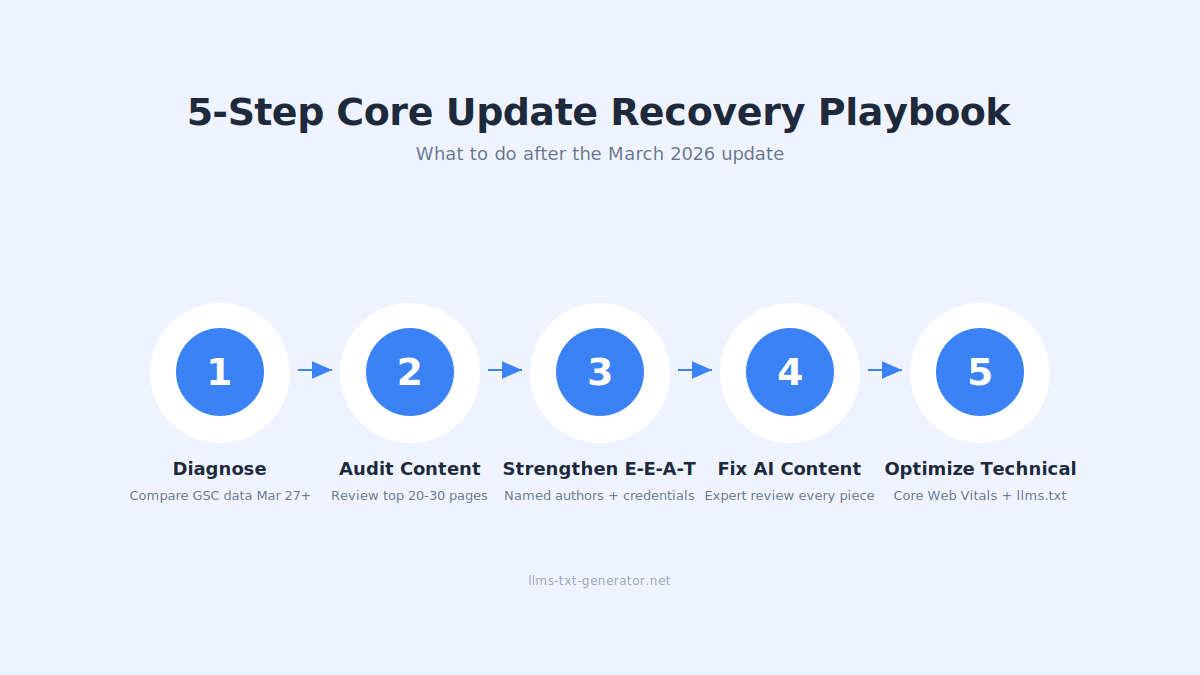
That's true — but it doesn't mean you do nothing. The next core update is expected in June or July 2026. Every improvement you ship now compounds by then. Here's the playbook:
Step 1: Diagnose (Week 1)
In Google Search Console, compare Performance data from March 27+ against the four weeks prior. Drops before March 27 likely tie to the spam update (March 24–25); drops after point to the core update. A 2→4 position drop is normal noise. A 4→29 drop warrants deep audit.
Important caveat: Google confirmed an impressions over-reporting bug running from May 13, 2025 until April 3, 2026. Clicks were unaffected. Expect impressions to appear to decrease as the fix rolls out — don't confuse this with core-update damage.
Step 2: Audit Content (Weeks 1–2)
Review your top 20–30 landing pages. Remove or consolidate thin pages. Identify pages where:
Content was AI-generated without editorial oversight
Pages target keywords outside your core expertise
Author attribution is "Staff Writer" or missing
Content hasn't been updated in 90+ days
Pages regurgitate common knowledge without new data or perspective
Step 3: Strengthen E-E-A-T (Weeks 2–4)
Add named authors with LinkedIn links, verifiable credentials, and first-person experience markers ("In my audits of 200+ sites..."). Cite primary sources. Update About pages with team credentials. Ensure every YMYL (Your Money, Your Life) page has clear authorship.
Step 4: Fix AI Content (Weeks 3–6)
AI as a drafting tool remains fine — 86.5% of top-ranking pages use it. What changed is the editorial bar. Every piece now needs expert review that adds:
Specific examples or case studies from real experience
A clear point of view or recommendation
Original data, screenshots, or first-hand testing
Primary source citations, not just links to other articles
Step 5: Optimize Technical Signals (Weeks 4–8)
Fix Core Web Vitals (INP replaced FID in 2024 — focus there first). Validate JSON-LD schema for Article, FAQ, HowTo, and Product pages. Publish a proper llms.txt file at your root domain to signal site structure and authority to AI engines. Reduce JavaScript execution and defer third-party scripts.
Recovery timeline expectations: partial technical recovery in 4–8 weeks. Full content-quality recovery typically arrives at the next core update (June/July 2026). Core update recoveries typically take 2–6 months total.
What's Next
Google's core updates are now shipping roughly every 3–4 months. Expect the next one in June or July 2026. Between now and then:
AI Overviews will expand to more query types (currently 25–48% of all searches, growing)
Information Gain will continue getting more weight
Site-level patterns will matter more than individual page quality
Verified author ecosystems (LinkedIn, GitHub, published research) will become ranking moats
llms.txt adoption will accelerate as AI citation signals get formalized
Conclusion
The March 2026 Core Update wasn't an anti-AI update. It was an anti-shortcut update. The sites that lost traffic treated content like a commodity — scaled output, anonymous bylines, generic coverage, no original research. The sites that gained treated content like a craft — named experts, documented experience, first-hand data, focused topical depth.
The same signals Google now rewards are the exact signals AI search engines use when choosing which sources to cite. This is the most important insight from the entire update: SEO and GEO have fully converged. Optimizing for one optimizes for the other.
The fastest first step you can take today is generating a proper llms.txt file. It gives both Google and every major AI engine a clean, structured map of your site — your purpose, your key pages, your expertise areas. It takes 60 seconds and costs nothing.
Generate your free llms.txt file now → and start rebuilding visibility for the next core update.
Frequently Asked Questions
When did the Google March 2026 Core Update start and end?
The update began on March 27, 2026 at 02:00 PT and completed on April 8, 2026 at 06:12 AM PDT. The total rollout duration was 12 days and 4 hours — one of the shortest core updates in recent memory.
Did Google penalize all AI content?
No. The correlation between AI usage and ranking penalties was 0.011 — essentially zero. 86.5% of top-ranking pages still use AI assistance. What got penalized was mass-produced AI content published without editorial oversight, original data, or verified expertise. AI used as a drafting tool with expert review performed fine.
Why did mass-produced AI content lose 71% of its traffic?
JetDigitalPro's analysis of 600,000+ pages found that content published at scale without editorial enrichment lost an average of 71% of organic traffic. The trigger wasn't AI itself — it was the absence of information gain, named authorship, and first-hand experience signals. Google is now algorithmically detecting "scaled content abuse" patterns at the domain level.
How do I know if my site was affected by the March 2026 Core Update?
Compare Google Search Console Performance data from March 27, 2026 onward against the four weeks prior. Drops before March 27 likely connect to the March 24–25 spam update. Drops starting March 27 indicate core update impact. Note that Google also fixed an impressions over-reporting bug on April 3, 2026 — expect impressions to appear lower as that fix rolls out (clicks were unaffected).
What is "Information Gain" and why does it matter now?
Information Gain is a Google patent concept that measures how much genuinely new information a page adds compared to the top 20 pages already ranking for a query. Pages that only restate common knowledge score low on Information Gain. Pages with original data, unique perspectives, or first-hand experience score high. This signal got significantly more weight in the March 2026 update, attributed to Google's "Gemini-powered semantic filter."
How long does recovery from a Google core update take?
Google's official guidance: biggest recoveries typically come at the next core update. Partial technical recovery (speed, schema, crawlability) can happen in 4–8 weeks. Full content-quality recovery generally takes 2–6 months and often requires the next core update to fully manifest. The next core update is expected in June or July 2026.
What's the connection between the core update and AI search (GEO)?
The ranking signals Google now weights heavily — information gain, verified author expertise, topical coherence — are the exact same signals AI search engines (ChatGPT, Perplexity, Google AI Overviews) use when selecting sources to cite. Optimizing for the March 2026 update simultaneously optimizes for AI citations. This is why "SEO" and "GEO" (Generative Engine Optimization) have functionally converged in 2026.
Does having an llms.txt file help with core update recovery?
Indirectly, yes. An llms.txt file signals topical coherence, expertise areas, and site structure to both Google and AI engines. It's not a direct ranking factor, but it reinforces the exact signals — organized content, clear authority areas, machine-readable authorship — that the March 2026 update rewards. You can create one for free at our llms.txt generator.
Should I delete all my AI-generated content?
No. Audit it instead. Pages that have genuine expert review, added examples, original insights, and verified authorship should stay. Pages that are pure AI output with no editorial value should either be rewritten with real expertise or removed. The trigger was editorial neglect, not AI use. Deletion is appropriate only for content that can't be meaningfully improved.
When is the next Google core update expected?
Based on Google's 2025–2026 cadence (every 3–4 months), the next core update is expected in June or July 2026. Sites working on content quality improvements now will likely see their biggest recovery movements when the next update ships. Fixes made between core updates compound for that future rollout.