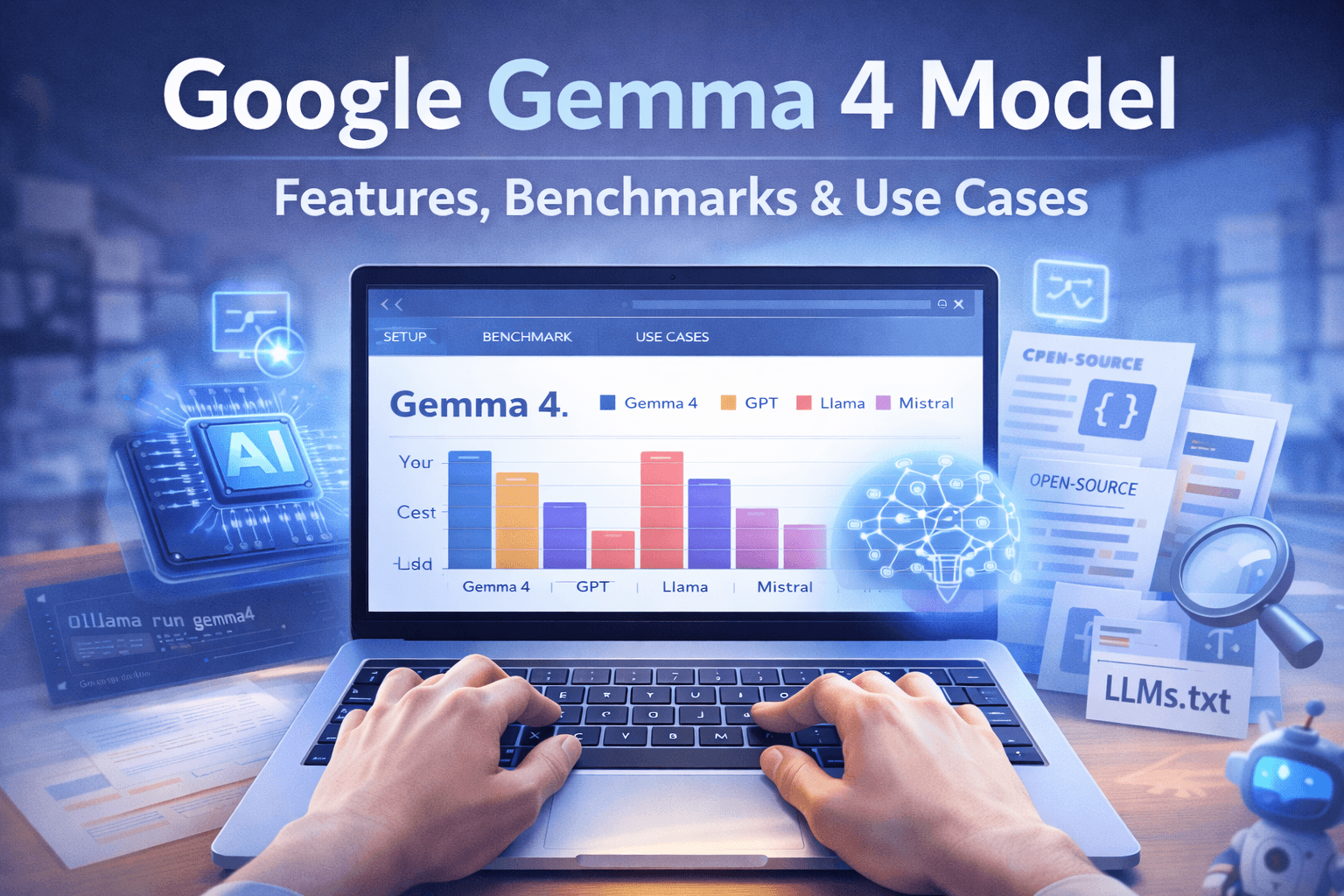
Google Gemma 4 is quickly becoming one of the most talked-about open-source LLM families in 2026. With rising API costs, privacy concerns, and the need for local AI setups, developers are actively searching for alternatives to cloud-based models like GPT.
If you're a developer, SEO professional, or AI enthusiast, this guide will help you understand:
- What Gemma 4 is and why it matters
- How it compares with GPT, Llama, and Mistral
- How to use Gemma 4 locally
- How to optimize your site for AI indexing using LLMs.txt
🚀 What is Google Gemma 4?
Google Gemma 4 is a lightweight, open-weight large language model family developed by Google DeepMind and built from the same research as Gemini 3. Released in 2026, it is designed to deliver strong reasoning, multilingual, and multimodal performance while being efficient enough to run locally on consumer-grade hardware.
Unlike massive proprietary models, Gemma 4 focuses on accessibility, safety, and developer control, offering model sizes ranging from the hyper-efficient E2B and E4B to the 12B Unified, 26B, and 31B parameter models — all released under a commercially permissive Apache 2.0 license.
Why It Matters
- Reduces dependency on paid, cloud-only APIs
- Supports privacy-first AI applications by running entirely offline
- Enables local AI agent workflows and low-latency prototyping
- Ships under Apache 2.0, removing the licensing restrictions of earlier Gemma generations
🧩 Key Features of Gemma 4
1. Native Multimodality
The larger variants natively process text, images, audio, and video in a single model — the 12B Unified model does so without separate encoder networks, enabling local vision, audio, and video tasks.
2. 256K Context Window
Models in the family support up to a 256K token context window, allowing you to feed in extensive documentation, code bases, or long-form books.
3. Extensive Multilingualism
Gemma 4 has been trained to support over 140 languages, enabling global AI agent and local chat applications.
4. Lightweight & Edge-Ready
Efficient quantization keeps the memory footprint small — the 12B Unified model runs on any laptop or workstation with just 16GB of RAM or VRAM while preserving high output quality.
5. Local Deployment Ready
Works seamlessly with tools like Ollama, Hugging Face, llama.cpp, MediaPipe, and LiteRT for local and on-device execution.
📊 Gemma 4 Benchmarks & Performance
Gemma 4 performs competitively well beyond its size class for coding, reasoning, and multimodal understanding. The flagship 31B model scores around 85% on MMLU Pro and roughly 89% on AIME 2026, ranking among the top open models on community leaderboards.
| Model | Speed | Cost | Accuracy | Local Run |
|---|---|---|---|---|
| Gemma 4 | ⭐⭐⭐⭐ | ⭐⭐⭐⭐⭐ | ⭐⭐⭐⭐ | Yes |
| GPT-5.5 | ⭐⭐⭐ | ⭐⭐ | ⭐⭐⭐⭐⭐ | No |
| Llama 3 / 3.2 | ⭐⭐⭐⭐ | ⭐⭐⭐⭐ | ⭐⭐⭐⭐ | Yes |
| Mistral / Mixtral | ⭐⭐⭐⭐ | ⭐⭐⭐⭐ | ⭐⭐⭐⭐ | Yes |
⚖️ Gemma 4 vs GPT vs Llama vs Mistral
| Feature | Gemma 4 | GPT-5.5 | Llama 3 | Mistral |
|---|---|---|---|---|
| Open Weights | Yes | No | Yes | Yes |
| Local Usage | Yes | No | Yes | Yes |
| Cost | Free (Local) / Low (API) | High | Free (Local) | Free (Local) |
| Ease of Setup | Easy (via Ollama) | Easy (API) | Medium | Medium |
⚙️ How to Use Google Gemma 4
Using Ollama
ollama run gemma4Using Hugging Face
Search for Gemma 4 models (e.g., google/gemma-4-12b-it) and load them using the Transformers library.
Local Setup
- Install runtime (Ollama or llama.cpp)
- Download your preferred model size (e.g., E4B, 12B, or 31B)
- Run locally on your machine
API Usage
You can expose local endpoints via Ollama or vLLM to integrate Gemma 4 directly into your custom applications.
💡 Real-World Use Cases
- AI chatbots: Highly efficient local conversational agents
- Content generation: Privacy-friendly offline writing helpers
- SEO automation: Processing data sets locally without uploading confidential data
- Code assistants: Running code-completion agents on-device
- AI agents: Running browser-automation and planning loops locally
🚨 Why Developers Need LLMs.txt
As local AI search and agent tools grow, websites need a standardized way to communicate with LLMs.
This is where LLMs.txt comes in. It helps:
- AI crawlers and local agents understand your content structure
- Improve your website's AI discoverability
- Increase the chances of your site being cited in AI search results
👉 Use this tool to generate yours:
🛠️ Step-by-Step: Generate LLMs.txt
- Visit the generator tool
- Enter your website details
- Customize the markdown rules
- Download the file
- Upload it to your root directory (e.g.,
yoursite.com/llms.txt)
This takes less than 2 minutes but can impact your AI visibility significantly.
✅ Pros & Cons
Pros
- Permissive Apache 2.0 license (free for commercial use)
- Local deployment for total data privacy
- Native multimodal (text, image, audio, video) and multilingual support
- Highly efficient execution that runs on 16GB-RAM hardware
Cons
- Lighter models have less reasoning depth than frontier models like GPT-5.5
- Requires technical setup for local deployment
🔮 Future of Open-Source LLMs
The AI ecosystem is rapidly shifting toward local-first AI, open-source innovation, and deep integration between AI retrieval systems and SEO. Google's Gemma 4 is a major milestone in this transition.
🎯 Conclusion
Google Gemma 4 is a powerful, efficient, and developer-friendly model family that enables robust local AI development. If you're building AI tools or optimizing for AI search, now is the time to act.
👉 Start by making your site AI-ready:
Generate your LLMs.txt file now
❓ FAQ
Is Gemma 4 better than GPT?
It depends on the use case. Gemma 4 is better for local, privacy-first, low-cost applications. Top-tier frontier models like GPT-5.5 are stronger for the most advanced reasoning tasks.
Can Gemma 4 run locally?
Yes, it is designed for local execution using runtimes like Ollama or llama.cpp, and the 12B Unified model runs on laptops with 16GB of RAM.
Is Gemma 4 free?
Yes, Gemma 4 is released under the permissive Apache 2.0 license, meaning it is free to download and use for commercial and research applications.