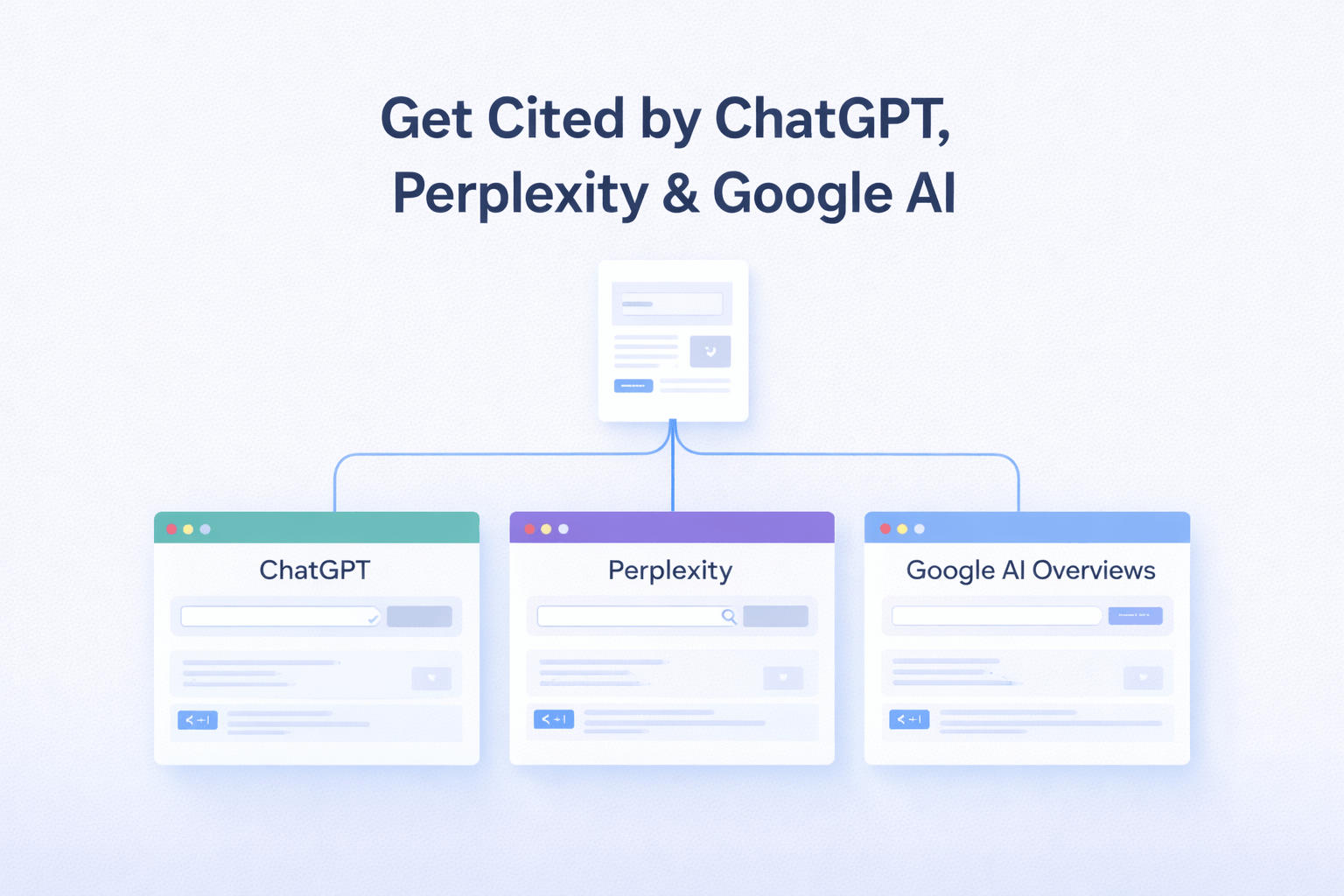
The New Rules of Visibility
Google's top 10 used to be the holy grail. In 2026, it's not enough — not even close. When someone asks ChatGPT a question, the sources it cites aren't necessarily the pages ranking #1 on Google. In fact, only 12% of URLs cited by ChatGPT and Perplexity rank in Google's top 10 results.
This is the single most important shift in search visibility since mobile-first indexing. Your website can be ranked #1 on Google and still be completely invisible to the 17.1% of searchers now using ChatGPT, the millions using Perplexity, and the billions encountering Google AI Overviews.
The good news? Each AI platform has patterns you can work with. Here's how to get cited by the three biggest AI search engines in 2026.
Why AI Citations Matter More Than Rankings
Traditional SEO focused on ranking in a list of 10 blue links. AI search gives users a single synthesized answer with a handful of cited sources. That means:
Fewer sources win — instead of 10 top results, AI answers cite 3-5 sources
Trust signals compound — being cited by AI builds authority with both users and other AI systems
Zero-click searches dominate — 60%+ of Google searches end without a click, making AI citations your best visibility lever
Click-through still happens — users who want depth click the cited source, and those clicks have higher intent
In other words: AI citations are the new featured snippets — except the competition is smaller and the reward is larger.
The Citation Landscape: Key Stats for 2026
Understanding where the AI search ecosystem stands today helps you make smarter content decisions:
| Metric | Value | Implication |
|---|---|---|
AI Overviews click drop | 34.5% | AI Overviews cut organic clicks significantly |
ChatGPT search share | 17.1% | Nearly 1 in 5 searches now go through ChatGPT |
Sites cited by both ChatGPT & Perplexity | Only 11% | Platform-specific optimization is essential |
Monthly source volatility | 40-60% | Cited sources change rapidly month-to-month |
Structured data citation boost | 3.1x more citations | JSON-LD is a major citation signal |
Fortune 500 with llms.txt | Only 7.4% | Massive early-mover opportunity |
URLs cited by AI also ranking in Google top 10 | Only 12% | AI visibility ≠ traditional SEO visibility |
These numbers make one thing clear: getting cited by AI requires a different playbook than ranking on Google.
How Each AI Platform Picks Sources
ChatGPT, Perplexity, and Google AI Overviews each have distinct preferences. Here's what the data shows about who they cite and why:
| Platform | Top Citation Sources | What It Favors | Primary Use Case |
|---|---|---|---|
ChatGPT | Wikipedia (47.9%), authoritative encyclopedic content | Well-structured factual content, clear definitions, expert authority | General knowledge, research, how-to answers |
Perplexity | Reddit (46.7%), community forums, real-world discussions | First-person experience, recent discussions, authentic voices | Product reviews, opinions, current events |
Google AI Overviews | YouTube (23.3%), multi-modal content, established publishers | Video content, structured pages, E-E-A-T signals | Visual explanations, quick factual summaries |
Notice how different the preferences are. A strategy that works for ChatGPT may do nothing for Perplexity — and vice versa.
How to Get Cited by ChatGPT
ChatGPT heavily favors encyclopedic, well-structured content. Here's how to position your site for ChatGPT citations:
1. Write Like an Encyclopedia, Not a Blog
ChatGPT cites Wikipedia in 47.9% of its answers. That's not a coincidence. Wikipedia's format — clear definitions at the top, structured sections, neutral tone, cited facts — matches how ChatGPT parses authoritative content. Open articles with a one-sentence definition, then build context from there.
2. Add an llms.txt File
ChatGPT's crawlers (GPTBot and ChatGPT-User) read llms.txt files to understand your site structure. Use our free llms.txt generator to create one that tells ChatGPT exactly what your site covers and which pages matter most.
3. Use Clear H2/H3 Structure
ChatGPT extracts answers from pages that have question-style headings (H2/H3) followed immediately by direct answers. Format your content so a 3-sentence answer appears right after each heading.
4. Add JSON-LD Structured Data
Sites with Article, FAQ, or HowTo schema get cited 3.1x more often. ChatGPT trusts structured data because it eliminates ambiguity about what a page is about.
5. Allow GPTBot in robots.txt
About 3.5% of sites accidentally block GPTBot. Check your robots.txt file and explicitly allow both GPTBot and ChatGPT-User user agents.
How to Get Cited by Perplexity
Perplexity behaves very differently. It heavily cites Reddit, forums, and community-driven content. Here's how to adapt:
1. Write in First-Person Where Appropriate
Perplexity favors authentic, experience-driven content. Case studies, first-person tutorials, and "here's what I found when I tested this" pieces perform dramatically better than generic listicles.
2. Publish Frequently and Stay Recent
Perplexity emphasizes freshness more than the other engines. Content from the last 30-60 days is heavily preferred. Update existing posts with new data, dates, and examples regularly.
3. Create Discussion-Worthy Content
Content that gets shared in communities (Reddit, Hacker News, niche forums) has a higher chance of being cited by Perplexity. Write pieces that invite discussion — controversial takes, honest comparisons, counter-intuitive findings.
4. Answer Long-Tail Questions Directly
Perplexity users ask very specific questions. Build pages around long-tail queries like "does llms.txt actually work for small business sites" rather than broad terms like "SEO tips."
5. Allow PerplexityBot
Make sure PerplexityBot is explicitly allowed in robots.txt. Perplexity also respects llms.txt files — another reason to generate yours today.
How to Get Cited by Google AI Overviews
Google AI Overviews operates closer to traditional SEO but with important differences:
1. Prioritize E-E-A-T Signals
Experience, Expertise, Authoritativeness, and Trust matter more than ever. Add author bios with credentials, link to authoritative sources, and include dates/updates on your content.
2. Answer the Question in the First 100 Words
AI Overviews pull direct answers from the top of pages. If your answer is buried in paragraph 5, you won't get cited. Lead with the answer, then expand with details.
3. Use Multi-Modal Content
YouTube accounts for 23.3% of Google AI Overview citations. Embed relevant videos, use images with descriptive alt text, and add diagrams that explain complex concepts.
4. Target Question-Based Queries
Pages titled "How does X work" or "What is X" get cited far more often than generic titles. Use Google's "People Also Ask" boxes as your keyword research tool.
5. Implement Comprehensive Schema
Article, FAQ, HowTo, Review, and Breadcrumb schemas all boost AI Overview eligibility. The more structured data you provide, the more likely Google's AI can confidently cite you.
The Universal Strategy: llms.txt + Structured Data
While each platform has quirks, two tactics work across all three:
llms.txt — The AI Sitemap
An llms.txt file gives every AI platform a clean, Markdown-formatted map of your website. It tells AI crawlers what your site is about, which pages matter most, and how content is organized. All three major AI platforms — ChatGPT, Perplexity, and Google's AI — can parse and benefit from it.
Use our free llms.txt generator to create yours in under 60 seconds. No signup required.
JSON-LD Structured Data — The Citation Multiplier
Schema.org markup in JSON-LD format gives AI platforms explicit, unambiguous metadata about your content. Pages with structured data get cited 3.1x more often across all major AI search engines.
Priority schemas to implement:
Article — For blog posts and news content
FAQPage — For FAQ sections (like the one at the end of this post)
HowTo — For step-by-step guides
Product — For commerce sites
Organization — For your company/brand identity
Platform-Specific Cheat Sheet
Here's a quick reference for optimizing for each AI search platform:
| Tactic | ChatGPT | Perplexity | Google AI Overviews |
|---|---|---|---|
llms.txt file | ✅ Critical | ✅ Critical | ✅ Critical |
JSON-LD structured data | ✅ Critical | ✅ Important | ✅ Critical |
Encyclopedia-style definitions | ✅ Critical | ❌ Less important | ✅ Important |
First-person experience content | ❌ Less important | ✅ Critical | ✅ Important |
Recent/fresh content | ✅ Important | ✅ Critical | ✅ Important |
Video/multi-modal content | ❌ Less important | ❌ Less important | ✅ Critical |
Community shares (Reddit/forums) | ❌ Less important | ✅ Critical | ❌ Less important |
Author bios / E-E-A-T | ✅ Important | ✅ Important | ✅ Critical |
Allow relevant bot in robots.txt | ✅ Critical (GPTBot) | ✅ Critical (PerplexityBot) | ✅ Critical (Google-Extended) |
Common Mistakes That Kill Your AI Citations
Even great content can fail to get cited if you make these mistakes:
Blocking AI crawlers: 3.5% of sites accidentally block GPTBot, ClaudeBot, or PerplexityBot in robots.txt
JavaScript-only content: If your content only renders with JavaScript, AI crawlers may never see it
Weak or missing meta descriptions: AI platforms use these as quick content summaries
No llms.txt file: You're leaving a huge signal on the table
Burying the answer: If the answer is in paragraph 6, AI skips your page
No author credentials: Google AI Overviews deprioritizes anonymous content
Outdated content: Perplexity especially favors content from the last 60 days
What Happens If You Do Nothing?
Being invisible to AI search isn't a neutral outcome — it has real consequences:
Lost traffic to competitors who optimize for AI citations first
Shrinking organic clicks as AI Overviews replace traditional results
Declining authority signals as AI increasingly shapes who's seen as an expert
Missed brand mentions in the answers millions of users now rely on
The gap between AI-visible and AI-invisible websites is widening every month. Early movers are locking in citation relationships that compound over time.
Conclusion
Getting cited by ChatGPT, Perplexity, and Google AI Overviews isn't a single tactic — it's a playbook tailored to each platform's preferences. But two fundamentals work everywhere: a well-crafted llms.txt file and comprehensive JSON-LD structured data.
Only 12% of websites cited by AI platforms rank in Google's top 10. That means ranking on Google is no longer enough. The websites winning the AI search era are building a parallel visibility strategy — one that speaks directly to how AI systems find, parse, and cite content.
The first step takes 60 seconds: generate your llms.txt file. The compounding returns of AI visibility start immediately.
Generate your free llms.txt file now →
Frequently Asked Questions
How do AI search engines decide which websites to cite?
Each AI search engine uses different signals. ChatGPT favors encyclopedic, well-structured content like Wikipedia. Perplexity heavily cites community sources like Reddit. Google AI Overviews prioritizes E-E-A-T signals and multi-modal content like YouTube videos. Across all three, structured data (JSON-LD) and llms.txt files significantly boost citation rates.
Does ranking in Google's top 10 mean I'll get cited by ChatGPT?
Not necessarily. Only 12% of websites cited by ChatGPT and Perplexity rank in Google's top 10 results. AI search engines use their own signals to choose sources, which is why optimizing specifically for AI citations matters.
What is the fastest way to improve my AI citation rate?
Three fast wins: (1) Generate and publish an llms.txt file — takes 60 seconds. (2) Add JSON-LD structured data (Article and FAQPage schema are easiest). (3) Check your robots.txt and explicitly allow GPTBot, ClaudeBot, PerplexityBot, and Google-Extended.
Do I need different content for ChatGPT vs Perplexity vs Google AI Overviews?
Ideally yes, but there's significant overlap. Focus on creating well-structured, authoritative content with a clear llms.txt file and comprehensive schema as your baseline — that works across all platforms. Then layer platform-specific tactics: encyclopedic formatting for ChatGPT, fresh first-person content for Perplexity, and multi-modal content with strong E-E-A-T signals for Google AI Overviews.
How often should I update content for AI citations?
For Perplexity, aim to update or republish key pages every 30-60 days — it heavily favors fresh content. For ChatGPT and Google AI Overviews, quarterly updates are sufficient for evergreen content, but news/data-driven pages benefit from monthly updates.
Can I control which AI engines crawl my website?
Yes. Use robots.txt to explicitly allow or disallow specific AI crawlers: GPTBot and ChatGPT-User (OpenAI), ClaudeBot and Claude-SearchBot (Anthropic), PerplexityBot (Perplexity), Google-Extended (Google's Gemini/AI), and Applebot-Extended (Apple Intelligence). Blocking an AI means losing citations from that platform entirely.
What is llms.txt and how does it help with AI citations?
llms.txt is a Markdown-formatted file placed at your domain root that tells AI models about your website's purpose, structure, and most important content. All major AI search engines can parse it, and it's a strong signal for citation eligibility. You can create one free at our llms.txt generator.
Which structured data schemas matter most for AI citations?
The highest-impact schemas are: Article (for blog posts), FAQPage (for FAQ sections), HowTo (for step-by-step guides), Product (for e-commerce), and Organization (for brand identity). Sites with structured data get cited 3.1x more often by AI search engines.
Is optimizing for AI citations replacing traditional SEO?
No — it's layering on top. Traditional SEO still drives significant traffic, but AI search is growing fast (ChatGPT already handles 17.1% of all digital searches). The smart strategy is maintaining strong traditional SEO while building a parallel AI citation strategy. Both share foundations: quality content, structured data, and clean technical setup.
How do I measure if AI engines are citing my website?
Manually: search your brand and relevant queries in ChatGPT, Perplexity, and Google (with AI Overviews enabled) to see if your site appears as a cited source. Tools are also emerging in 2026 specifically for tracking AI citations — expect more mature tracking solutions to emerge throughout the year.